


The Android XR smart glasses have moved far away from simple audio, camera capabilities, and voice assistant integration. The Google Android XR ecosystem seeks to merge AI, Android applications, spatial computing and the physical world through headsets and glasses. One such fascinating product is the XREAL AURA.
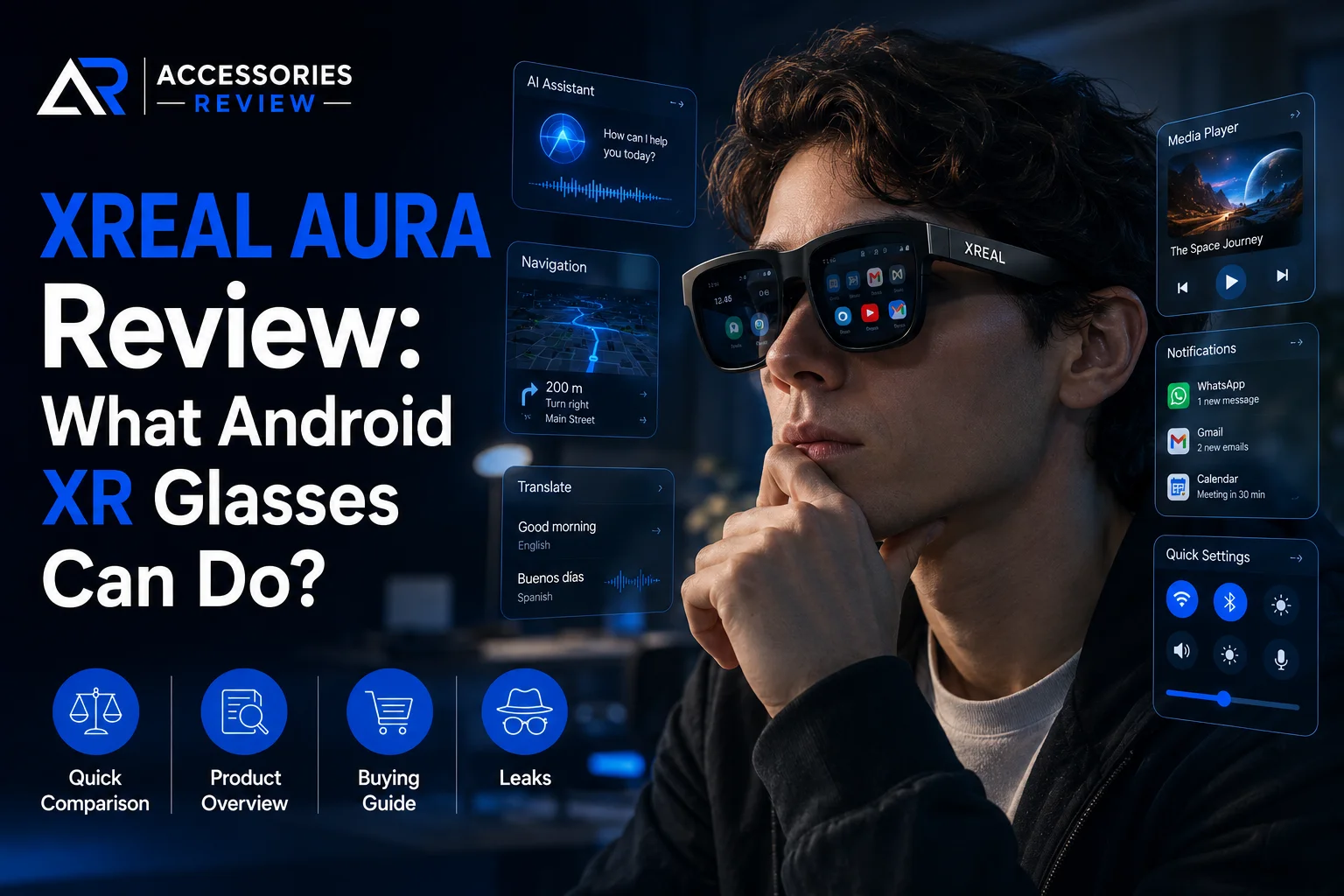
Different from regular AI glasses, XREAL AURA has a 70-degree optical see-through display, spatial tracking, hand tracking and a separate compute puck, allowing it to deliver virtual displays and spatial experiences while still able to see the environment around.
For U.S customers, the release date for the XREAL AURA is Fall 2026, and the XREAL company promises that the base model will have a final retail price under $1,500 (without taxes). The reservation for it is already available.
But the bigger question is rather simple: do Android XR smart glasses provide any value for the price?
What Are Android XR Smart Glasses?
Android XR is Google’s operating system for extended reality devices like headsets and glasses. Extended reality involves technologies that bring digital information into the real world in the form of augmented reality, mixed reality, and virtual reality. Android XR is adding Android apps, spatial experiences, and Gemini AI into this environment.
In simple terms, Android XR is an attempt to reduce the dependency of computing on a phone, laptop, or actual monitors. It allows you to interact with digital information without having to look down at the screen because it lets you use your eyes and hands in any way you see fit.
Therefore, Android XR glasses are different from regular AI glasses. Traditional AI glasses are mostly focused on providing audio features including speakers, microphones, voice calls, music, notifications, and voice assistance. Display-based XR glasses add visual aspects making virtual screens and spatial apps available.
Android XR was created by Google in collaboration with Samsung and Qualcomm, but some other brands such as XREAL manufacture the hardware. Gemini is responsible for the AI layer, which means that there is an assistant in Android XR who can process vocal requests and, where applicable, visuals.
XREAL AURA: The Android XR Glasses to Watch
XREAL AURA is the company’s first wired XR glasses that run on Android XR. Instead of being an ordinary headset, it has been made from lightweight glasses and a separate computing puck.
The glasses work on optical see-through technology which implies that digital contents will be seen by you even when you see the real environment. XREAL says about AURA that it is a portable spatial computer for entertainment and productivity purposes and any other XR application.
The device has been made using some technical specifications including 70-degree field of view, Sony Micro-OLED screens, spatial tracking, hand tracking, Gemini, and Snapdragon Reality Elite by Qualcomm. The company also mentions that inserts with prescription lenses will be provided in AURA.
Just to remind one thing, Google creates Android XR but not the AURA glasses which have been developed by XREAL itself.
XREAL AURA Specs at a Glance
The Android Xreal Smart AI Glasses give real tech experience. These glasses have perfect design and they give the user real-time AI usage experience.
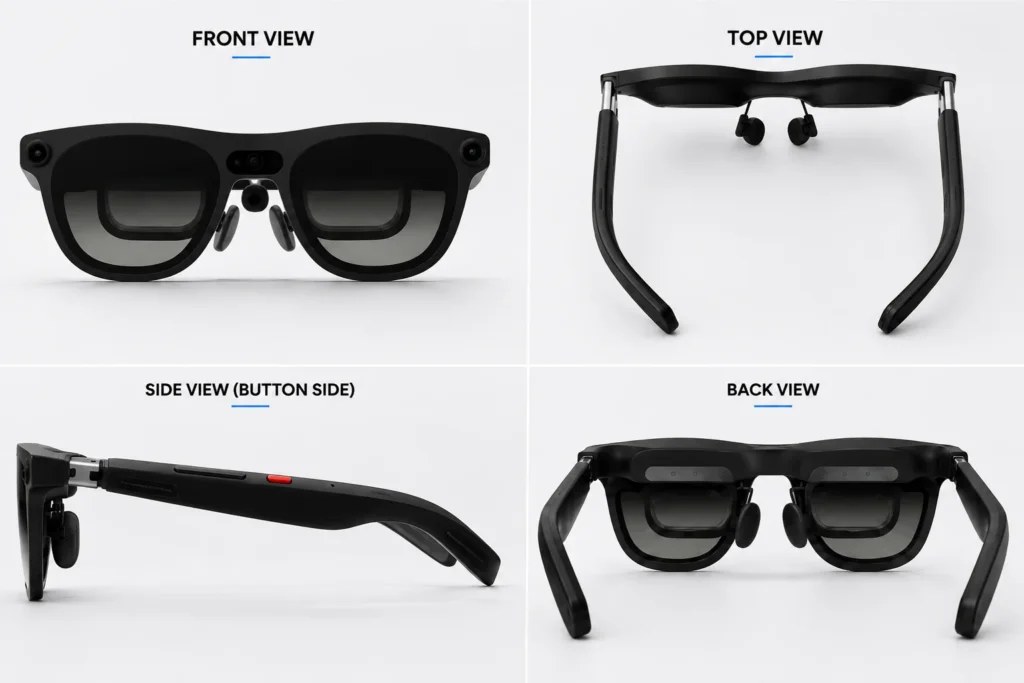
| Specification | XREAL AURA |
| Platform | Android XR |
| Display | Sony Micro-OLED |
| Resolution | 1920 × 1200 per eye |
| Refresh rate | Up to 120Hz |
| Field of view | 70° |
| Glasses weight | Under 95g |
| Main processor | Snapdragon Reality Elite |
| Glasses processor | XREAL X1S Spatial Coprocessor |
| RAM | 12GB / 16GB |
| Storage | 256GB / 512GB |
| Compute battery | 4,455mAh / 34.84Wh |
| Tracking | 6DoF + hand tracking |
| AI | Google Gemini |
According to XREAL, the Snapdragon Reality Elite platform is integrated within the compute puck, whereas the X1S spatial coprocessor is installed in the glasses.
What Can You Actually Do With Android XR Smart Glasses?
It is here that Android XR smart glasses become more intriguing than a technical specification. It all comes down to having access to digital data while not always having to look down into your smartphone.
Watch Movies on a Giant Virtual Screen
AURA can provide a spacious personal viewing area to enjoy movies, TV shows, sports and other forms of content. This might come in handy during flights, in hotels, during trips or when you want to watch something privately without using a TV.
For frequent travelers within the United States, the concept is simple – instead of carrying a portable display, you will carry glasses and a compute puck.
Create a Portable Workstation
It is also possible for AURA to serve as a spatial work environment where compatible apps and devices can offer virtual screens for surfing, documentation, communication, and other tasks.
This would be appealing to remote workers, developers, designers, and business travelers looking for a bigger work environment without having to carry numerous physical screens.
On the other hand, Android XR offers access to known Android apps via Google Play; however, developers can create specific experiences for XR. Google says that it is a platform which consists of an app and game ecosystem for XR devices.
Use Gemini as a Visual Assistant
Gemini makes the concept more useful because the assistant can work around your environment. Google has demonstrated Android XR glasses answering questions about things users see, providing directions, translating text, summarizing information, and helping with hands-free tasks.
Navigation
Navigational help is one more possible strength. The company has shown how the device can offer guidance using glasses without the necessity to take out one’s smartphone again and again. This might be helpful while navigating through airports, strange U.S. towns, and tourist spots.
But for driving, one must never let the interface interfere with their attention.
Gaming
AURA may be used as a personal gaming display as well. The glasses may be used with computers and handheld gadgets and wireless controllers and will provide gamers with a large virtual display without having to carry a traditional monitor.
It means that gaming, watching movies and working are three actual applications that may give an additional value to the display itself.
My Experience With XREAL AURA
The smart glasses left an amazing impression on me because of their advanced features like Gemini AI visuals, voice control, hand tracking, and spatial display – features that make them look like devices from the future generation of computing with artificial intelligence.
The thing that I particularly enjoyed was talking to the Gemini AI about what I see and getting real-time instructions.
What Stood Out
- Less than 95g
- Hand tracking
- Up to five virtual screens
- Voice control and app management
- Electrochromic dimming
- Gemini-powered visual assistance
My favorite feature:
Gemini’s ability to guide me through tasks while I interact with the real world.
XREAL AURA Display: Is 70° FOV Actually Better?
One of the most significant features of AURA that differentiates it from standard display glasses is the 70-degrees field of view. This glasses are equipped with Sony Micro-OLED panels with 1920 × 1200 resolution per eye and up to 120Hz refresh rate.
So what does 70-degrees really mean?
Field of view will determine how much area your display will be able to occupy visually. More visual space will be able to make your virtual windows, games, and video content feel like an extended spatial experience rather than a tiny floating screen.
This feature will play an essential role in case you are working with several virtual windows. In addition, you will be able to feel the movie or game more expansive.
Another key difference of AURA glasses is an optical see-through concept. Unlike other headsets, the user is not looking into a closed box but rather using a device that integrates digital content with the real world.
For those users who value the balance of the two worlds, this is a significant benefit.
Gemini on Android XR: Is Google’s AI Actually Useful?
Gemini is key to the Android XR approach of Google. It is not enough to have a chatbot in your glasses; Gemini will learn about the context and help you without distracting from the physical reality.
You can ask it something you see around, translate languages, navigate somewhere, or look up information without taking out your smartphone. Google has already shown visual queries, navigation, translations, messaging, and many other hands-free interactions with their Android XR glasses models.
It is fascinating to compare this approach to the approach of Meta AI in Ray-Ban Meta ecosystem. Both ecosystems have started using cameras, microphones, and context-aware AI. However, AURA has added spatial display and Android XR environment.
In this way, Gemini will be useful for those tasks that require both viewing and displaying some information, rather than hearing it.
The problem is that actual experience may vary depending on the number of applications available and your location. Thus, it is better to evaluate AURA as an evolving XR platform, not as a ready-to-use substitute for all phone functions.
Cameras, Privacy and Recording: What U.S. Buyers Should Know
Cameras are very important in the XR world since there are spatial devices that should know about movements and surroundings. The AURA device makes use of cameras and sensors for spatial tracking, among other experiences, and there is hand tracking as well in this system.
Privacy cannot be overlooked at all. Camera-enabled glasses can cause worries for some people especially when worn near other people in the workplace, restaurants, schools, or even in private places.
Google has admitted that privacy is one of the key issues to be considered in the creation of Android XR glasses, and has tried to test the prototypes on users in order to learn more about the correct way to use this technology.
When purchasing, the rule for buyers is simple. Follow all the laws of your country and the social requirements before recording anyone and any conversation.
Why Does XREAL AURA Need a Compute Puck?
The compute puck is probably the most unusual part of AURA.
Instead of placing all the processing hardware and battery inside the glasses, XREAL separates the system into two parts. The glasses contain the display and spatial coprocessor, while the puck contains the main Snapdragon Reality Elite processor, memory, storage, battery, and other computing hardware.
That approach has an obvious benefit: the glasses can remain lighter and more comfortable than a device carrying the entire computer on your face.
The puck also provides substantial computing resources. XREAL lists configurations with 12GB RAM and 256GB storage or 16GB RAM and 512GB storage.
But there is a trade-off.
You have to carry the puck, and the glasses connect to it with a cable. That makes AURA less self-contained than conventional smart glasses.
For travelers, developers, gamers, and remote workers, carrying a small computer may be a reasonable trade. For someone who wants simple, cable-free smart glasses, it could be the biggest reason to choose something else.
Real Hands-On Experience With Android XR Smart Glasses
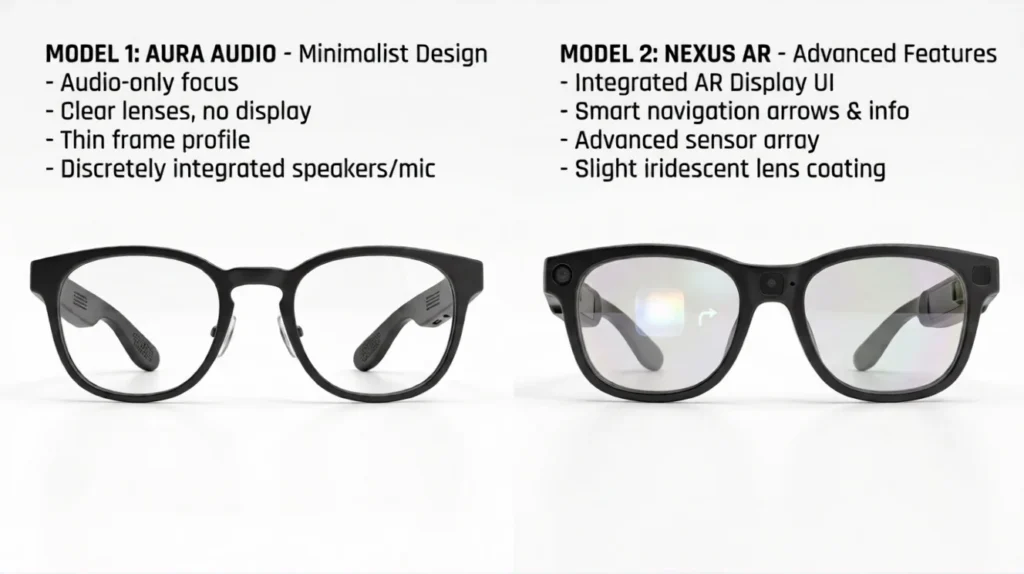
Early hands-on demos reveal that Android XR glasses are surprisingly lightweight compared to older AR devices. The arms are slightly chunky due to internal hardware, but overall comfort has improved significantly.
Some real-world interactions include:
- Asking Gemini to play music and control media
- Identifying objects in real time (e.g., board games, items, products)
- Capturing photos and editing them using AI prompts
- Saving instructions directly into apps like Google Keep
One standout feature is Gemini Live, which allows continuous conversation without repeated wake commands.
Android XR Glasses Price & Release Date in the U.S.
The XREAL AURA release date is now set for the Fall of 2026. Reservations are available, and XREAL claims that those who reserve early gain early access once the product hits the market.
Newer, official prices are much more accurate compared to earlier guesses. According to the company, the base version’s final retail price will not be above $1,500 before taxes. Still, the final retail price and configuration have not been announced by the company just yet.
That is why buyers need to differentiate between the maximum $1,500 price point and the confirmed selling price at $1,500.
Current reservation offers also include a $99 Launch Credit which will increase to $199 at the time of the product launch. The Founder Priority Pass worth $299 has already been sold out.
XREAL AURA vs Ray-Ban Meta: Which Is Better for Americans?
| Feature | XREAL AURA | Ray-Ban Meta |
| Category | XR display glasses | AI smart glasses |
| Display | Yes, 70° | No |
| AI | Gemini | Meta AI |
| Spatial computing | Yes | Limited |
| Hand tracking | Yes | No comparable XR system |
| Cameras | Yes | Yes |
| Virtual screens | Yes | No |
| Compute | External puck | Integrated |
| Best for | Work, media, XR | AI, calls, audio, camera |
| Portability | Glasses + puck | More self-contained |
Which One Should you buy?
Choose XREAL AURA if you want spatial computing, virtual displays, immersive entertainment, hand tracking, and an Android XR environment.
Choose Ray-Ban Meta if your priority is everyday AI assistance, calls, music, photography, and a more conventional smart-glasses experience.
The important point is that these products are not identical competitors. Ray-Ban Meta is designed around making ordinary glasses smarter. AURA is designed around turning glasses into a portable spatial computer.
Are Android XR Smart Glasses Good for Work and Travel?
In terms of work, AURA would find its application in situations where people working remotely do not want to drag a portable monitor. Developers, designers, writers and business travelers will enjoy the opportunity to have a workspace that follows them wherever they go.
Traveling is another great application for AURA. On an airplane, it can be used for a personal entertainment screen. In a hotel, one can create a bigger workspace or a movie screen with it. At the airport, one could navigate around the place with AURA and access information without checking a smartphone all the time.
The only thing that remains to be decided is whether a person wants to carry around the compute puck and the cable.
Who Should Buy XREAL AURA?
XREAL AURA is ideal if you are looking for an Android XR, Gemini, virtual display, spatial computing, hand tracking, and immersive entertainment glasses experience.
It is specifically attractive to remote workers, developers, gamers, travelers, XR lovers, early adopters, and everyone who loves having multiple screen capabilities.
Who Should Skip XREAL AURA?
It might not be the right choice for you if you care mostly about phone calls, music, photo taking, or just regular AI assistance. This might not be the best choice either if you hate cables, do not want to carry a compute puck, or if you want traditional-looking glasses.
Is XREAL AURA Worth Buying in the U.S.?
XREAL AURA is not only a new pair of AI glasses; it is more like a step towards integrating Android XR and spatial computing into a glasses form factor.
The major strengths of this product include its 70 degrees optical see-through screen, Gemini chip, virtual screens, hand tracking, Android applications, and dedicated compute architecture.
The main challenges are the high cost, wired nature, dedicated compute puck, and the fact that this is still a developing platform.
For U.S. consumers who desire spatial computing in their glasses and not just an AI assistant, XREAL AURA could be one of the most interesting Android XR products in 2026.
FAQs
What are Android XR smart glasses?
These are glasses built on Google’s Android XR platform that utilize AI, Android applications, sensors, displays, and capabilities for spatial computing.
How much do Android XR glasses cost?
According to XREAL, the AURA base unit will not be priced higher than $1,500 excluding tax, even though the final selling price remains unknown.
When will Android XR glasses be released in the U.S.?
XREAL AURA is planned for release in Fall 2026, while according to Google, its Android XR intelligent eyewear ecosystem is growing in 2026 as well.
Is XREAL AURA made by Google?
Not necessarily. XREAL produces AURA devices, but Google supplies the Android XR platform and Gemini integration.
Does XREAL AURA use Gemini?
Yes. AURA operates on Android XR and is designed to offer Gemini-powered spatial experiences.
Does XREAL AURA have a display?
Yes. Uses Sony Micro-OLED panels with 1920 x 1200 resolution per eye and 120Hz refresh rate.
Can XREAL AURA replace a monitor?
Can be used as a private virtual display for entertainment and work with compatible software, but cannot be seen as a universal substitute for every physical screen.
Can you use XREAL AURA for gaming?
Yes. Spatial display can be used for playing games on compatible hardware and controllers.
Can you wear prescription lenses with XREAL AURA?
Yes. According to XREAL, the AURA headset is compatible with insertable prescription lenses.
