

Updated on August 10, 2026.
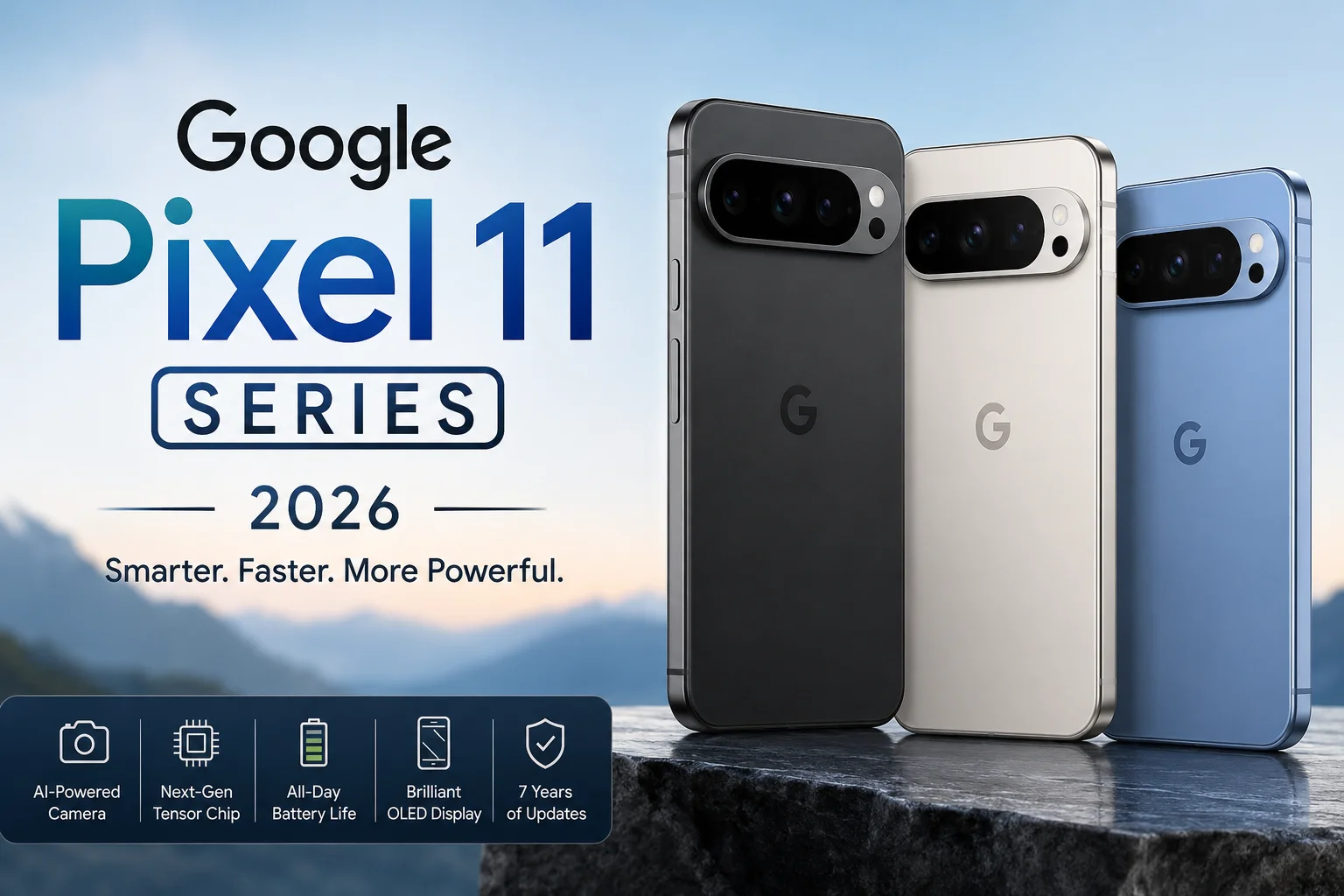
Google Pixel smartphones have earned a name for their excellent computational photography, clean android OS, and advanced AI features. The coming Google Pixel 11 maintains this tradition but with some upgrades and no radical redesign. According to various reliable sources, the new series is anticipated to come with the Tensor G6 chip, the first ever flagship chip made by Google using 2nm TSMC process technology, along with enhanced integration of Gemini AI, better storage capacity, improved connectivity, and a new HiLight notifications system. Although most of the talk revolves around specs, consumers now ask the following: Is the Pixel 11 worth waiting for? Are there any tangible improvements brought by Tensor G6? Is the anticipated price rise justifiable? This guide will answer these questions.
Google Pixel 11 Release Date and Expected Price
The release date for the Pixel 11 series phones is slated to be made public during the Made by Google event at New York on August 12, 2026, after which pre-orders will commence right away. The phones are projected to hit the market starting from August 20, 2026, following the established trend at Google of late. Based on the latest information available, it appears that the phone series will consist of four variants – Pixel 11, Pixel 11 Pro, Pixel 11 Pro XL, and Pixel 11 Pro Fold.
However, there is an increase in the price of about $100 from the last generation of smartphones. At present, the basic model of the Pixel 11 is expected to cost about $899, the Pixel 11 Pro about $1,099, the Pro XL version about $1,299, and the Pixel 11 Pro Fold about $1,899. Although such increased prices may bother the customers, Google is making efforts to offset some of that extra price in the form of 256GB storage capacity in place of 128GB.
Google Pixel 11 Expected Specifications
| Feature | Expected Specification |
| Display | 6.3-inch OLED, 120Hz |
| Processor | Google Tensor G6 (2nm TSMC) |
| RAM | 12GB or 16GB |
| Storage | 256GB / 512GB |
| Rear Camera | 48MP–50MP Main Camera |
| Front Camera | 13MP |
| Battery | Approximately 4,985mAh |
| Connectivity | 5G, Wi-Fi 6E, Bluetooth 6.0 |
| Operating System | Android 17 with Gemini AI |
These specifications are based on multiple industry reports and should be considered expected until Google officially confirms them.
Design and Display
Such specs are based on several industry reports and can be treated as the expected one before official confirmation from Google.
In fact, instead of a radical change of design, Google is developing a good solution further. Some rumors suggest that the Pixel 11 will keep the classic camera bar but will make it a bit slimmer and add some hardware refinements. In addition, Google Pixel 11 is likely to be a bit lighter but durable enough.
The front of the device will get a 6.3 inch OLED screen with adaptive refresh rate which will vary between 60Hz to 120Hz. Thus, you will be able to experience fluid scrolling, fast gaming, and energy-efficient display performance. In addition, the resolution of Google Pixel 11 is expected to be 1280 × 2856 px and protected by Gorilla Glass Victus 2 which makes Google Pixel 11 competitive among other high-end devices in terms of screen specifications.
Tensor G6: The Biggest Upgrade That Matters
The most notable upgrade expected in the Google Pixel 11 is the new Tensor G6 processor. It is reported that the new chip is manufactured by TSMC and uses a sophisticated 2nm process, unlike other Tensor processors, which are made by Samsung. It is important because heat management and power consumption are among the biggest issues in past Pixel devices.
Google’s strategy with its Tensor processors does not lie in pure benchmarking but emphasizes AI performance, photo computations, battery performance, and fast performance. The more efficient fabrication process means that the chip can carry out basic operations more effectively without using as much power, which implies less heating, longer battery life, and better sustained performance.
Also, it is notable that there is rumored to be a switch from the Samsung modem to a MediaTek one, which will increase stability and reliability of the signal and 5G connection. Many users have experienced problems with signal quality and modem draining their battery life.
The Tensor G6 processor would not be able to make mobile games reach Snapdragon standards for the majority of American customers; however, the new smartphone will become more proficient in areas where Pixels are already outstanding due to their built-in AI – photo shooting, voice recognition, multitasking, and everyday work. In contrast to Snapdragon developers who are obsessed with benchmarks, Google looks ready to offer its users smarter solutions with the help of AI-powered machine learning on device.
AI Features, Battery, and Unique Pixel 11 Upgrades
AI is likely to continue being the major reason to pick up the Google Pixel 11 over rivaling smartphones from other Android brands. Instead of developing the artificial intelligence separately, Google continues incorporating the Gemini into Android in order to simplify people’s everyday lives. The Pixel 11 will be capable of completing most of the AI-related tasks on the spot thanks to improved TPU in Tensor G6 and an additional imaging coprocessor. The new approach will increase user privacy, shorten the response time, and allow the use of numerous features even without a proper connection to the Internet.
From a user’s point of view, all the mentioned innovations are going to bring tangible results instead of just numbers. The Gemini will be able to summarize long emails, create replies, make notes organized, translate conversations, plan trips, rewrite documents, and answer complicated questions with the help of AI that works directly on the phone. Google Photos will get even more advanced tools for working with pictures, which will enable the removal of unnecessary objects from photos, reduction of noise, background extension, improvement of low light pictures, and video enhancement.
Tensor G6 should also boost battery performance because of its high efficiency instead of increasing the capacity of the cell. As indicated by some reports, the standard Pixel 11 should come with the battery of 4,985 mAh and advanced power management to adapt the processes in the background and refresh rate. With the 2nm manufacturing process, it is logical to expect enhanced endurance when using the smartphone for web surfing, video streaming, navigation, photos, and multitasking. While there are no guarantees about increased charging speed, the battery experience in general is supposed to be better due to the improved efficiency.
Another problem solved in the new Pixel 11 is connectivity. The adoption of a different chip by Google for the connection to mobile networks, namely MediaTek modem, is likely to bring more reliable 5G connectivity, reception in problematic areas, and enhanced battery performance while using mobile Internet. At the same time, compatibility with Wi-Fi 6E and Bluetooth 6.0 can contribute to wireless experience.
Unique Features That Differentiate the Pixel 11
Out of all the upgrades that have been speculated, HiLight notification system seems to be the standout feature of Pixel 11. Known as Pixel Glow previously, HiLight is set to light up whenever the phone will be kept upside down, letting the user know about important calls, messages, and interactions through Gemini. While nothing is confirmed about HiLight yet, it can be said that the system is quite different from the Glyph Interface of Nothing Phone as it utilizes large programmable LED strips. Unlike Samsung’s Edge Lighting and Apple’s Dynamic Island, HiLight seems to offer a dedicated notification system for the rear of the phone, without having to keep the display on.
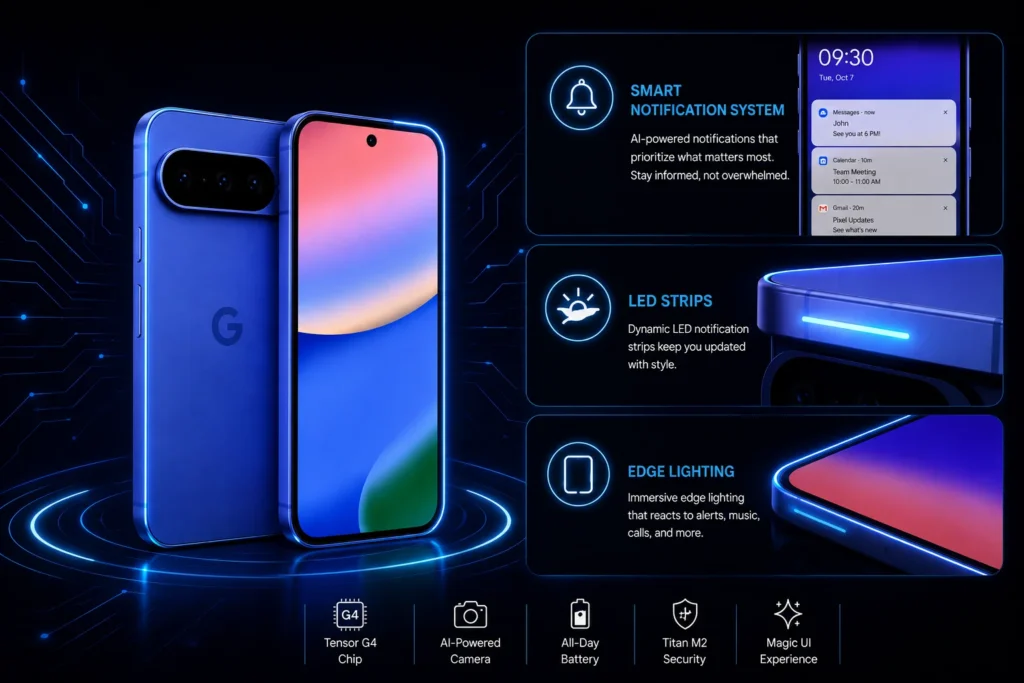
A worthwhile development in this case will be the report of choosing 256GB as the default storage capacity. Although an additional $100 for the phone may be disappointing at first, it means that you get twice the amount of default storage space for recording high-resolution videos, using AI-created content, downloading games, and having plenty of offline content.
Once again, the emphasis will be on computational photography, machine learning, security, and software rather than achieving the best performance metrics possible. This has been the strategy behind successful Pixel phones in relation to their rivals among Android devices.
Google Pixel 11 Camera: AI-Powered Photography Gets Smarter
In all previous years, Google has managed to keep its smartphones as leaders when it comes to photography capabilities, and the Pixel 11 won’t be an exception in this trend. While hardware enhancements seem to be rather moderate, computational photography and AI algorithms will be responsible for providing the most notable advancements. The reports say that the main camera of the Pixel 11 smartphone will have 48 MP-50 MP resolution and will be equipped with an improved imaging pipeline based on Tensor G6. As opposed to the rise in megapixel count, Google is going to prioritize faster HDR, improved Night Sight, enhanced skin tone accuracy, better zoom, and even more efficient AI image editing.
Also, Gemini will probably play an important role in the camera usage experience by allowing people to remove unnecessary objects, expand the background of the image, correct portrait lighting, reduce motion blur, and create professional-looking photographs effortlessly. Moreover, videos taken with the Pixel 11 will be stabilized by AI, and voice isolation and low-light shooting will be noticeably improved. Thus, instead of competing for the largest camera sensors, Google continues to rely on intelligent software processing.
Google Pixel 11 vs Samsung Galaxy S26, iPhone 17 & OnePlus 15
The Google Pixel 11 faces competition from the best flagships of 2026. While Samsung concentrates on premium hardware, Apple places emphasis on ecosystem integration, and OnePlus on performance, Google still benefits the most from its key assets, which include Gemini AI, computational photography, and software longevity.
| Feature | Pixel 11 | Galaxy S26 | iPhone 17 | OnePlus 15 |
| Best For | AI & Photography | Productivity | Apple Ecosystem | Performance |
| Processor | Tensor G6 | Snapdragon 8 Elite Gen 2 | Apple A20 | Snapdragon 8 Elite Gen 2 |
| AI | Gemini AI | Galaxy AI | Apple Intelligence | OnePlus AI |
| Camera | Best computational photography | Best zoom | Best video | Balanced flagship |
| Battery | Excellent efficiency | Excellent | Very Good | Good |
| Charging | Moderate | Fast | Moderate | Fastest |
| Updates | 7 Years | 7 Years | Long-term | 4–5 Years |
| Base Storage | 256GB | 256GB | 128GB* | 256GB |
Which should you buy?
- Choose the Pixel 11 if you want the most intelligent AI capabilities, good camera work, and stock Android with updates for many years.
- Choose the Galaxy S26 if you care about multitasking capabilities, S Pen support, and the best screen from Samsung.
- Choose the iPhone 17 if you are already locked into Apple’s ecosystem and care about video recording.
- Choose the OnePlus 15 if gaming and fast charging capabilities are your priorities.
Most American consumers will find the Pixel 11 to be the best Android flagship device that strikes a balance between AI capabilities, camera quality, software life cycle, and affordability in 2026.
Who Should Buy the Google Pixel 11?
The Pixel 11 is ideal for those who prioritize intelligence in software over mere specifications. The phone will be very ideal for mobile photographers, fans of Android, Google Workspace professionals, travelers who need live translations, students, and people looking to get more software updates for long periods of time. Users moving from either the Pixel 8, Pixel 9, or other flagship phones are bound to see some changes in performance and efficiency.
Who Should Skip It?
For existing users of the Pixel 10, the differences might not be much unless the enhancements in the artificial intelligence capabilities and the HiLight functionality help their daily work processes. Those who are mobile game enthusiasts looking for better frame rates will most likely opt for the Qualcomm chips. Also, those looking for faster charging will most probably favor OnePlus products.
Pros and Cons
Pros
- Tensor G6 used a highly optimized 2nm TSMC process.
- Gemini AI advanced features included in Android.
- 256GB of base storage offers better longevity.
- High-end computational photography capabilities.
- Android OS update support promised for seven years.
- New modem with improved connection.
- Clean, safe, and packed with Pixel software.
Cons
- $100 increase expected.
- It may be slower when charging compared to some of the competition.
- The camera hardware does not change a lot.
- It may underperform gaming-wise compared to the Snapdragon flagships.
- Most upgrades will be made on the software side.
Buying Advice
According to current news, the 256 GB base model will definitely be the best bang for your buck among all the options for most U.S. customers. This device provides sufficient internal memory for storing high-resolution photos, AI content, offline entertainment, as well as upcoming software upgrades, without immediately having to purchase the pricier version. Customers also need to take into account the promotions and trade-ins offered by Google when purchasing this new smartphone.
When it comes to the purchase of accessories, a USB-C charger, a case, a tempered glass screen protector, and Pixel Buds can still be quite useful. For those who plan on taking full advantage of Gemini AI, Google’s cloud storage packages can also be useful.
Frequently Asked Questions
Is the Google Pixel 11 worth waiting for?
Indeed, especially when using a Pixel 8 and older phones to enjoy more powerful AI technology, increased battery life, and enhanced efficiency.
Will the Pixel 11 have better battery life?
The 2nm architecture and efficient power management in the Tensor G6 chip will boost the battery life compared to previous Pixel phones..
Is the Pixel 11 good for photography?
Indeed. The computational photography, AI editing software, and other image processing by Google are still among the best in the industry.
Should Pixel 10 owners upgrade?
However, if you do not require the new AI technologies, increased storage, or HiLight notifications, the upgrade is unnecessary.
Final Verdict
While the Google Pixel 11 seems like more of an evolution than a revolution, there are quite a few features which cater specifically to consumer pain points. In this case, Google is not making changes to its hardware, but instead, improving battery efficiency, AI capabilities, connectivity, longevity and storage. The Tensor G6, Gemini AI, HiLight notifications system, and 256GB of storage as a standard seem to form a good daily experience for the majority of users.
For consumers in the U.S. market, who are seeking an innovative flagship Android smartphone that prioritizes great photo capabilities and intelligent software at all times, Pixel 11 looks like one of the most interesting phones to appear in 2026. Provided Google does manage to meet all its promises and keeps prices affordable via trading in options and launch discounts, the Pixel 11 may prove to be the most intelligent Android smartphone purchase.
You can also read these blogs for guide to buy Samsung Galaxy Z Fold 8, Motorola Razr Fold &
